
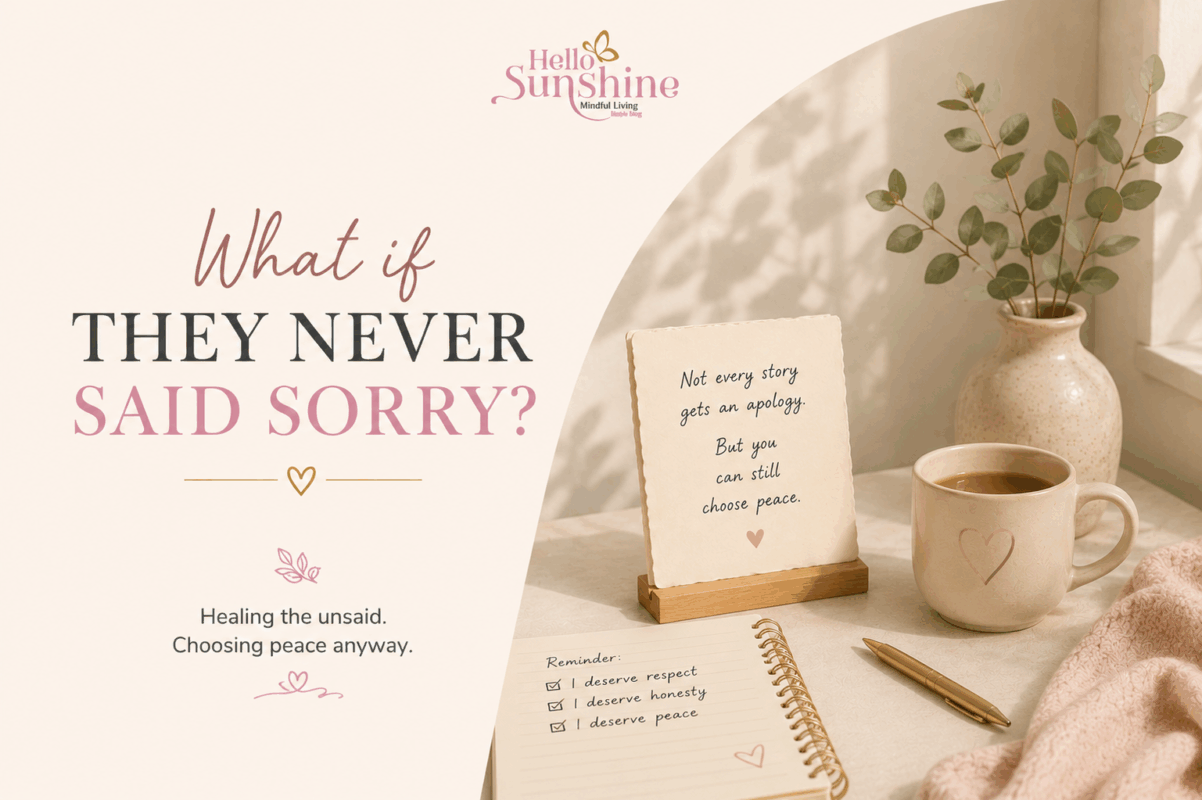
Okay, so. Let’s talk about something most of us don’t say out loud.
There’s someone in your life — maybe more than one — who owes you a sorry.
You know exactly who I mean. You didn’t even have to think about it. The name just showed up in your head the second I said that sentence.
And here’s the part that stings a little — they’re probably never going to say it.
Not because they don’t know what they did. But because some people just don’t have it in them. They weren’t built with the muscle for it. Or they have too much pride. Or, honestly, they’ve just moved on, while you’re still sitting with it.
I used to think I needed that apology to move forward. Like it was a key, and the door to my own peace was locked until they handed it over.
Turns out — I had a copy of that key the whole time.
There’s a line I read once, by Pema Chödrön, that I think about more than I’d like to admit. She says, “Nothing ever goes away until it has taught us what we need to know.”
And for the longest time, I thought the lesson was about them. What they did. Why they did it. How they could live with themselves.
But the actual lesson — the one that took years to land — was about me. About what I was outsourcing to someone who clearly wasn’t going to deliver.
Here’s something I had to learn the hard way — and I think you’ll recognize this.
Your brain holds onto people. Not just the big, dramatic memories. The small stuff. The way they laughed. A certain song. The particular quiet of a Sunday evening that somehow still belongs to them, even years later.
And sometimes, completely out of nowhere, in the middle of an ordinary Tuesday — you miss them. No warning.
No trigger you can point to.
That’s not you being weak or stuck.
That’s just memory doing its job. It’s normal. Let it visit when it shows up.
Just don’t let it move in.
So here’s what actually helped me, and I want to be honest about it — when my friend told me about it, it felt a little silly the first time I did it.
I wrote them a letter.
Everything I never got to say. Everything I’d rehearsed in my head a hundred times at 2 a.m. And then — the part that mattered more — everything I wished they had said back to me. The apology. The explanation. The acknowledgment that what happened, happened.
I wrote all of it. Pages of it.
And then I didn’t send it.
I burned it. Actually burned it — in an ashtray on my balcony, feeling slightly ridiculous, like I was in a film. But something happened when I watched the paper curl up and disappear. It wasn’t about them reading it. It never was. It was about me finally saying it.
Out loud. On paper. For myself.
And here’s the thing I had to understand, slowly, over time.
One apology. One last conversation. One answer that finally makes everything make sense — that’s what we think we need. We tell ourselves, if I just understood why, I’d finally be at peace.
But closure isn’t something anyone else can hand you. It’s something your mind is hoping will take the pain away.
And even if you got every answer you’ve ever wanted — you’d be surprised to find you still hurt. Because the pain was never really in the why. It was in the loss.
The disappointment. The future that never came.
Our brains crave certainty. Uncertainty feels unfinished, so the mind keeps searching for a reason solid enough to finally let go.
But life rarely gives us that kind of assurance. And needing it — that’s what keeps us stuck.
Healing happens the day you stop needing the answers to live a full life.
I want to tell you about a friend of mine — this happened a couple of years ago.
She’d had a massive falling out with her mother. Something was said at a family function, in front of everyone, the kind of comment that cuts because it comes from someone who’s supposed to protect you, not embarrass you. She waited for an apology for almost three years. It never came. Her mother never even brought it up again — like it hadn’t happened.
But one random afternoon, in the middle of the week, her mother called. Said she’d made her favourite dessert. “Will you come? It will go bad otherwise.”
No sorry. No mention of what happened.
My friend went anyway. Sat at the table.
Ate two bowls of it. And somewhere in between, she told me, she just felt this calm settle over her. Like something heavy had finally been put down.
She said, “I think that was her apology… she just doesn’t have the words for it.”
I think a lot of us grew up around people who show love and regret sideways.
They don’t say sorry — they show up with food. They don’t say, “I missed you” — they call and ask if you’ve eaten. It’s frustrating, honestly. But once you learn to read it, it’s kind of beautiful.
I think we’ve been sold this idea that closure has to be a scene. A big conversation. An apology delivered on cue, like in a movie, where the other person finally says the thing you’ve been waiting to hear, and then everything resolves instantly.
Real life doesn’t work that way.
Most people you needed an apology from will never give you one. And waiting for it means handing them control over your peace, indefinitely, for free.
So write the letter. Burn it. Say the thing out loud to an empty room if you have to.
Give yourself what you stopped expecting from them. It won’t fix everything overnight — but it’ll give you somewhere to start.
Because here’s the truth, plain and simple —
Closure is not a person. It’s a decision.
And healing happens the day you stop needing the answers — to live a full life anyway.
