
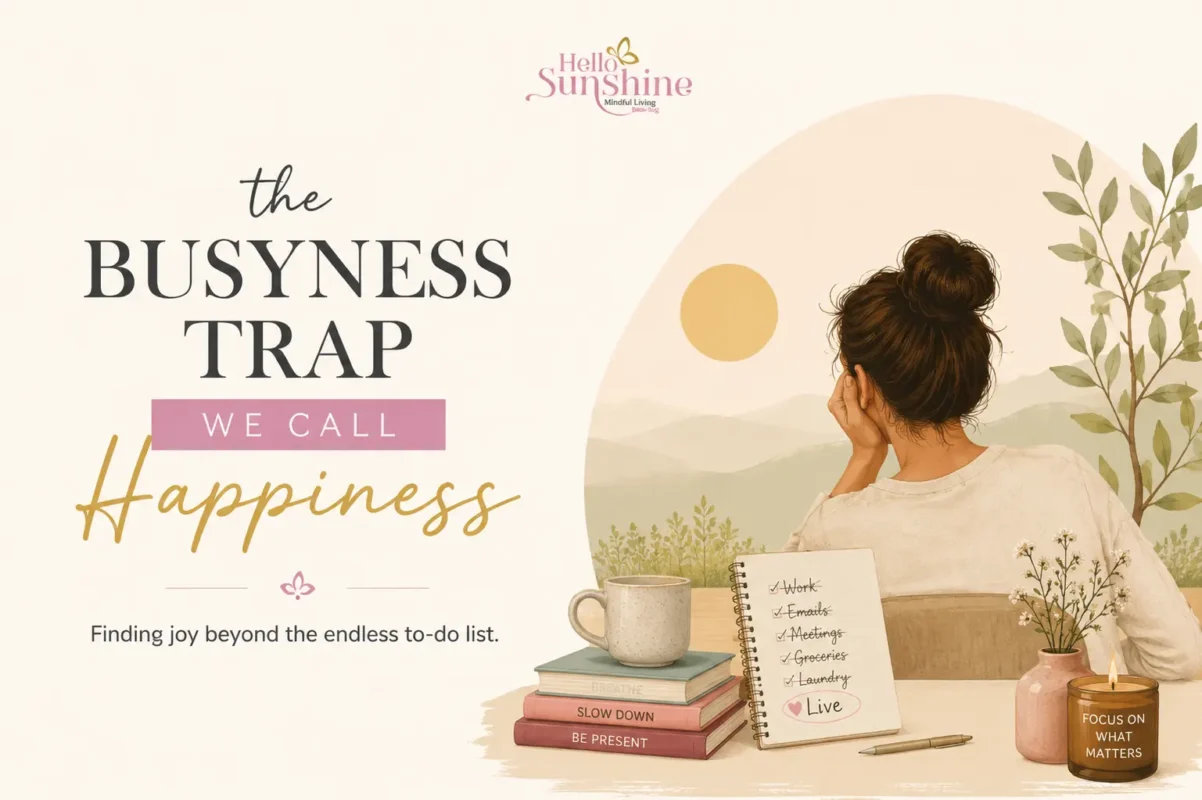
Okay, quick question. And I want you to answer honestly, just to yourself.
When was the last time you were bored?
Not restless. Not between tasks. Actually, genuinely, sit-with-yourself bored.
Can’t remember? Yeah. Me neither. And I think that’s one of the quietest crises of our time — that we have engineered boredom out of existence, declared war on stillness, and called it progress.
Welcome back. Today we’re going to talk about happiness. Specifically, the very convincing imposter that’s been showing up in its place.
Here’s the modern happiness formula that most of us follow:
Wake up. Check your phone before your eyes have fully focused — because what if something happened while you were sleeping? Scroll for seventeen minutes. Feel vaguely terrible. Make coffee. Put on a podcast — because silence is apparently now a texture we can’t tolerate. Get ready. Drive to work. Put some music on. Arrive. Work. Lunch — but not alone, God no, Netflix on the laptop. Evening: choose between six streaming platforms for forty minutes and then rewatch something you’ve already seen. Sleep. Wake up. Repeat.
And somewhere in between all of that — we call it living.
Now here’s the part that should make us all deeply uncomfortable: none of that is happiness. Not a single item on that list. But it feels like happiness. It feels like fullness. Like a life well-lived.
What it actually is is distraction. Very high-quality, algorithm-optimised, dopamine-calibrated distraction.
And we have confused the two so completely that most of us wouldn’t recognise actual happiness if it sat next to us on a park bench.
Which, as it turns out, it sometimes does.
There was a study done — and I promise this is real, not the kind of “studies show” that podcasters use to sound credible while making things up — researchers at Harvard followed over 2,000 people throughout their days using an app that would ping them randomly and ask two things: What are you doing right now? And how happy are you?
What they found was striking. People’s minds were wandering — not present in what they were doing — roughly 47% of the time. Almost half their waking life, gone. Drifting.
And here’s the gut-punch: a wandering mind, they found, is almost always an unhappy mind. It didn’t matter what people were daydreaming about. Positive fantasies, neutral thoughts — didn’t help. The mind away from the present moment was reliably, measurably less happy than the mind in it.
47% of our lives, we are somewhere else. And we have built an entire economy to help us get there faster.
I have a friend — let’s call her Meera. She didn’t mind me sharing this story but was not too happy to give me her actual name.
Meera went through a rough patch a couple of years ago. Difficult breakup, job stress, the full catastrophe. And she told me she got through it by staying constantly busy. Gym in the morning. Packed social calendar. New hobby every other week — pottery, then running, then — and I say this with love — she tried aerial yoga, which is exactly what it sounds like and somehow worse.
She was, by all appearances, thriving. Everyone said so. “Meera’s doing so well. Look how much she’s doing.”
And then one Sunday, every plan fell through. Friends cancelled. Gym closed. No class, no brunch, no noise. Just Meera. Alone. In her apartment.
And she called me crying — not because something bad had happened, but because she’d felt something. For the first time in months, the stillness had cracked her open and what came out wasn’t sadness exactly. It was herself. The part she’d been outrunning.
She said, “I’ve been so busy being okay that I forgot to actually be okay.”
She’s one of the wisest people I know. And she figured it out the hard way — which is the only way most of us do.
Here’s the thing about distraction. It’s not evil. It’s not even wrong. We need it. Rest, play, entertainment — these are real and human and good.
The problem is when distraction becomes our default response to being alive.
Bored? Scroll. Sad? Binge. Anxious? Busy. Lonely? Notifications. We have an app for every emotion and a subscription for every ache, and we have medicated the human experience so thoroughly that we’ve forgotten what it feels like to just be — without producing, consuming, or performing anything at all.
And happiness — real happiness, the deep-in-the-chest, nothing-is-missing kind — doesn’t live in stimulation. It lives in presence. In the unguarded moment. In the conversation where you forget to check your phone. In the meal that you actually tasted. In the walk where you weren’t listening to anything and you noticed, suddenly, that the evening light was doing something extraordinary to the trees.
Happiness is shy. It doesn’t show up when the room is too loud. It needs a little quiet to find you.
And we have made quiet the enemy.
Blaise Pascal — 17th-century French philosopher, mathematician, genius, and apparently a man who saw the future — wrote something that should be tattooed somewhere visible.
He said: “All of humanity’s problems stem from man’s inability to sit quietly in a room alone.”
Seventeenth century. No smartphones. No algorithm. No Netflix. And he’d already understood it.
The inability to be alone with yourself — truly, uncomfortably, quietly alone — is not a modern invention. But we have given it modern superpowers. We have built a civilisation of escape hatches. Every pocket now contains a portal to anywhere but here.
And we wonder why, despite being the most entertained generation in human history, we are also among the most anxious, the most restless, the most quietly hollow.
I’m not going to tell you to delete your apps. I haven’t. I’m not going to tell you to meditate for an hour every morning.
But I will say this.
The next time you reach for your phone because a moment felt quiet — pause. Just for a second. Ask yourself: am I bored, or am I just not used to being here? Being with myself and allowing myself to feel?
Because there’s a version of you that exists underneath all the noise. That has opinions and feelings and a rich, inner world that doesn’t need content. That version of you is not broken or incomplete or in need of optimisation.
That version of you is just waiting for you to stop running long enough to say hello.
If this resonated, sit with it. Don’t share it immediately. Don’t turn it into a caption. Just let it be a thought you had, on a day you were present enough to have it.
That’s already something.
Title: A Little Average, A Little Happy
Hey. Welcome back. Pull up a chair, grab whatever you’re drinking, and let’s talk about something that nobody puts on a vision board.
Being average.
I know. I know. You felt a little something just hearing that word, didn’t you? A small flinch, maybe your lips have pursed. Like someone said “mediocre” or “giving up.” Stick with me.
We live in a world that is absolutely deranged and obsessed with excellence and overachieving.
Your LinkedIn feed is a highlight reel of people disrupting industries at 24. Your Instagram is fitness models who “just eat intuitively.” Your podcast recommendations are all billionaires explaining how they only sleep four hours because they’ve “optimized their rest.”
And somewhere in the middle of all that, you’re sitting there trying to remember if you drank enough water today.
I want to tell you about my friend Sridhar.
He is not extraordinary by any measurable standard. He’s not going to be on the cover of Forbes. He’s not building an app. He works a government job — nine to five, same desk for eleven years. He comes home, tends to this ridiculous little vegetable garden he’s obsessed with, cooks dinner for his family, and watches cricket and reruns that he’s already seen.
And here’s the thing — Sridhar is one of the happiest people I have ever met in my life.
Like, genuinely, quietly, annoyingly happy.
I used to feel a little sorry for him. I thought he lacked ambition. I thought he’d settled. And then one evening I’m sitting in his garden, eating tomatoes he’d grown himself, and he says to me — completely unbothered —
“I like my life. I know you think I could have done better, but I like my life. Every part of it. Do you like yours?”
And I — the one with the goals and the self-improvement podcasts and the five-year plan — had absolutely nothing to say.
Sridhar wasn’t average because he’d failed to be exceptional. He was average because he’d chosen a life that fit him. And that, it turns out, is extraordinarily hard to do.
Here’s what nobody tells you: the pursuit of extraordinary is often just anxiety holding an iced coffee … inner peace yet to load.
We don’t chase greatness purely because we love growth. A lot of the time, we chase it because we’re terrified that if we stop — if we just are who we are — it won’t be enough. That we won’t be enough.
Average, in this culture, has become a moral failing. But think about what average actually means. It means you’re human. It means you’re in the middle of the bell curve — which is, by definition, where most of life happens. The greatest loves, the longest friendships, the Sunday mornings that feel like mercy — none of that shows up on a performance review.
The average parent who shows up every single day? That child will remember it forever.
The average friend who answers the phone at midnight? That call changes a life.
The average employee who does honest, decent work and goes home without burning out? That person is still here in ten years, which is more than you can say for a lot of hustle-culture heroes.
The writer Kurt Vonnegut (vaw-na-gut — brilliant, strange, worth reading) once said something that I think about more than I’d like to admit. He was at a party with his friend Joseph Heller, and someone pointed out that their host, a hedge fund manager, had made more money in a single day than Heller had earned from Catch-22 in its entire lifetime.
Heller turned to Vonnegut and said: “Yes, but I have something he will never have. Enough.”
Enough.
That word is so quiet. And so devastating. Because we are living in a culture that has declared war on “enough.” Enough has been rebranded as complacency. Contentment has been repackaged as a problem to be solved.
But Heller — who had written one of the greatest novels of the twentieth century — knew something the hedge fund manager might not. That the finish line of more doesn’t exist. And if you’re always running toward it, you never get to stand still and notice that you’re already somewhere worth being.
Now, I’m not saying don’t have dreams. Dream wildly. Work hard. Try things that scare you.
But I am saying this: let “average” breathe a little. Let it mean something other than failure.
Because the most radical thing you can do in a world screaming at you to optimize, scale, and outperform — is to look at your ordinary Tuesday, your unremarkable dinner, your small and quietly beautiful life, and say: this is enough. I am enough.
Sridhar figured that out with a tomato garden.
The rest of us are still working on it.
That’s it for today. If this hit something in you, share it with someone who needs permission to slow down. And if you’re a high achiever who absolutely hated this episode — I respect you. Go disrupt something.
I’ll be here. Being average. Talk soon.
